

Why is Lean Failing?
We want to be lean, and the desire is genuine. It's not from lack of effort, by being here it is obvious you want to be better. But despite this, the results aren't showing. The problem isn't a lack of trying; it's that our efforts may be misaligned, unfocused, or missing the foundational elements that make lean thinking effective. Something deeper needs to change before we can truly move forward.

Stop Focusing on Cost
The Scenario
Removing wastes, one of the great pillars of Lean Implementation. But Lean fails because you’ve focused on reducing cost; less machines, reduced headcount, and scaled back production. On paper, it looks like you’ve succeeded, expenses are indeed down. Congratulations you did it… you’ve just stagnated your business. Without additional capacity there is no room for more revenue, there is no room for growth, there is no direction for improvements.
The Lean Way
This is a common misconception about Lean, a trap if you will, when people take on on their lean journey they focus on the reduction of wastes. It is assumed that less waste = less cost. In fact the reverse is true, Lean Implementation initially costs more. Lean is an investment: an investment in your processes, your people, and your capacity. When done right, it leads to faster lead times, higher productivity, and a stronger competitive edge. You invest in having a competitive advantage.
When your competitors take a month to deliver and you do it in two weeks, with better quality and lower cost, you win the market. Every. Single. Time.
If you’ve been chasing cost reduction, you’ve been chasing the wrong goal. It is a misconception to believe you need to reduce cost: you need to increase productivity. By becoming lean it means you increase the value the customer sees in your product. You grow your business with lean, increase the revenue and the profit follows. Your cost might not decrease, but your profit will increase.
The reality is, the average worker doesn’t care about lean.
The Scenario
Let’s face the ugly truth most workers couldn’t care less about lean.
You introduce it, run a few training sessions, maybe hang up some posters. But deep down, there’s resistance. Why? Because lean usually feels like just another top-down initiative, another way to micromanage, another reason to change something that "was working just fine." Most people don’t want to be told how to do their jobs differently. They don’t see how it helps them, only how it complicates things. And frankly, they’ve heard it all before.
The Lean Way
Lean, at its core, isn’t about control. It’s about improvement, real, measurable, lasting improvement. It’s a mindset shift that helps companies operate smarter and employees work with purpose. But for lean to truly succeed, it has to be embraced, not enforced. That’s where many organizations fall short. The secret lies in how you introduce it: not as a set of rules, but as a way to empower people. Through methods like Rapid PDCA (Plan, Do, Check, Act), you shift the focus from changing the work to changing behaviors with your team fully involved every step of the way.
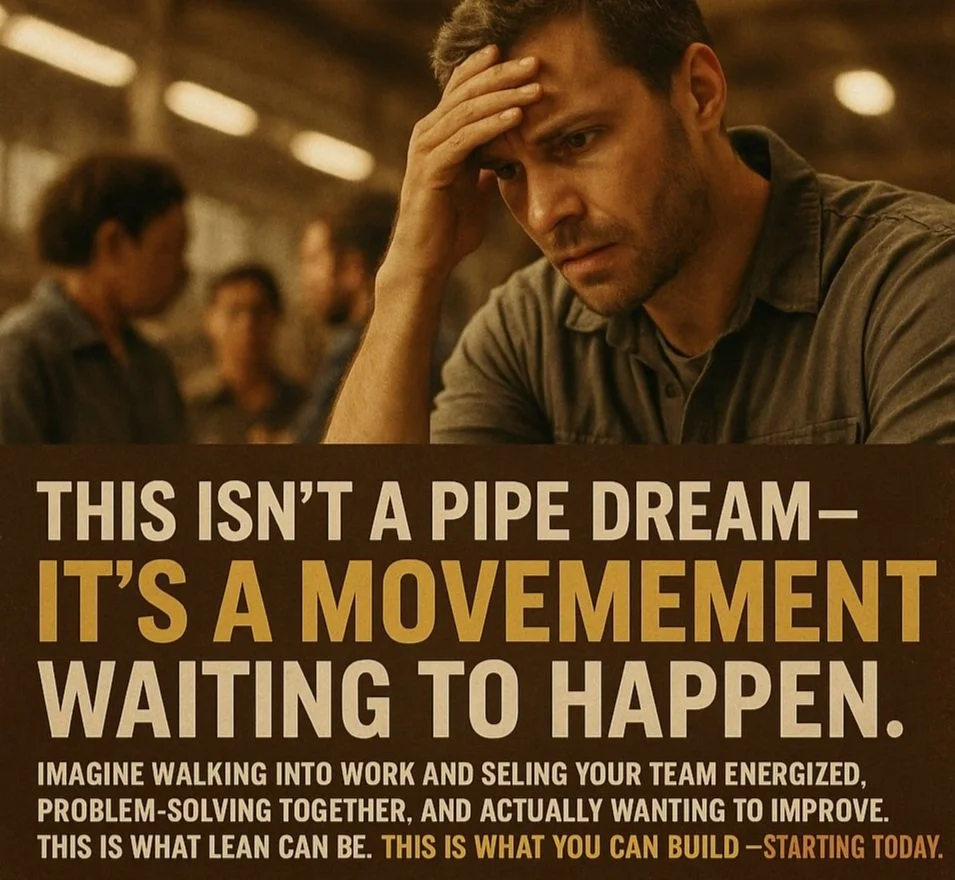
You don’t need consultants who talk at your staff or systems that overwhelm your floor. You need practical, proven techniques that inspire your people to take ownership. We’ve developed a framework that does exactly that, easy to apply, natural to adopt, and most importantly, built around the people who make your business run. Imagine walking into work and seeing your team energized, problem-solving together, and actually wanting to improve.

You’ve set the wrong metrics
The Scenario
You set a goal. You miss it. And then you slap that failure up on a board for everyone to see. Sound familiar? Maybe you're aiming for 200 tyre and rim sets a day and hitting only 160. That’s 80%, right? So you mark it down 80%. Now your team knows they’ve failed. Again. What message does that send? Not only have you fallen short on output, but you’ve also driven morale into the ground. And tomorrow? You’ll probably get the same or worse. This isn’t accountability. It’s demoralizing. And worst of all? Your customers still don’t care about your internal targets.
The Lean Way
Traditional percentage-based metrics don’t offer improvement; they offer judgment. They lower morale, mask the real issues, and cap your growth mindset. Lean manufacturing flips this on its head. Instead of fixating on what you didn't hit, it focuses on what you did achieve and how to build from it. Producing 160 units? Good. Now ask: What held us back? What’s our next step forward? Lean thinking replaces static targets with dynamic improvement. You’re not chasing perfection you’re building momentum.
This is more than just metrics. This is about your people, your culture, and your future. Every wheel set you didn’t produce today is a missed opportunity tomorrow. But every step forward, no matter how small, is a win if you're focused on growth. Stop accepting 100% of yesterday’s limit as the ceiling for tomorrow. Don’t settle for “good enough.” Start setting targets that inspire, not punish. Dream bigger. Aim for 300, 500, even 1,000 units a day. Because when you remove the limits, your team doesn’t just perform better they believe again.

You and your staff are too busy for Lean
The Scenario
You’re swamped. Your managers are swamped. Your staff can barely keep up. Lean requires time investment, it's one of the biggest challenges all companies face when deciding to take lean into manufacturing. We have this manic obsession with everyone being busy all the time. In a typical business manufacturing industry, if everyone is working, I’m making money right? Deep down, you know the answer. You're stuck in a cycle where there's no time to improve because you're too busy firefighting issues that really shouldn’t be problems.
The Lean Way
Lean requires time, lots of time. And yes, that’s often the biggest hurdle. Lean isn’t about doing more, it’s about solving the root of issues so they don’t occur again. Unfortunately, there isn’t a one-size-fits all situation. Because lets be honest, I can’t imagine a single manager or owner willing to shutdown production to do lean; lean in itself is a wasteful activity.
There are several solutions you could undertake:
Hire dedicated Improvement Manager or Improvement Engineer
Redefine your manager’s roles to include lean responsibilities or;
Temporarily slow production to create space for change
Use the resources and tools Accessible Lean Consulting provides you
The end goal is the same: unlock hidden time by eliminating waste. Lean is about smarter flow, reduced downtime, and just-in-time systems that reduce the clutter not just physically, but operationally as well. When you start down the path of lean, you will find time you didn’t know you had available.
Lean offers you the chance to break free from that chaos. Imagine walking into work and knowing your team has clarity, focus, and breathing room, because you've designed it that way. As you impart on your journey into lean manufacturing, as the time decrease to produce, as you reduce production output to just-in-time manufacturing and reduce inventory levels. You will find time open up in different areas. The key here is that DOWNTIME = IMPROVEMENT TIME.
Break the logic of “everyone working all the time is profitable”.